Demain Demos Philharmonie
REPORT
Initiated by the Cité de la Musique and the Philharmonie de Paris, the Démos program has been democratizing instrumental practice in areas with insufficient cultural institutions for ten years. Our contributor, Géraldine Dormoy, attended a rehearsal with the orchestra in eastern Paris, which DEMAIN has been supporting for three years.
Demos, an orchestra for self-discovery
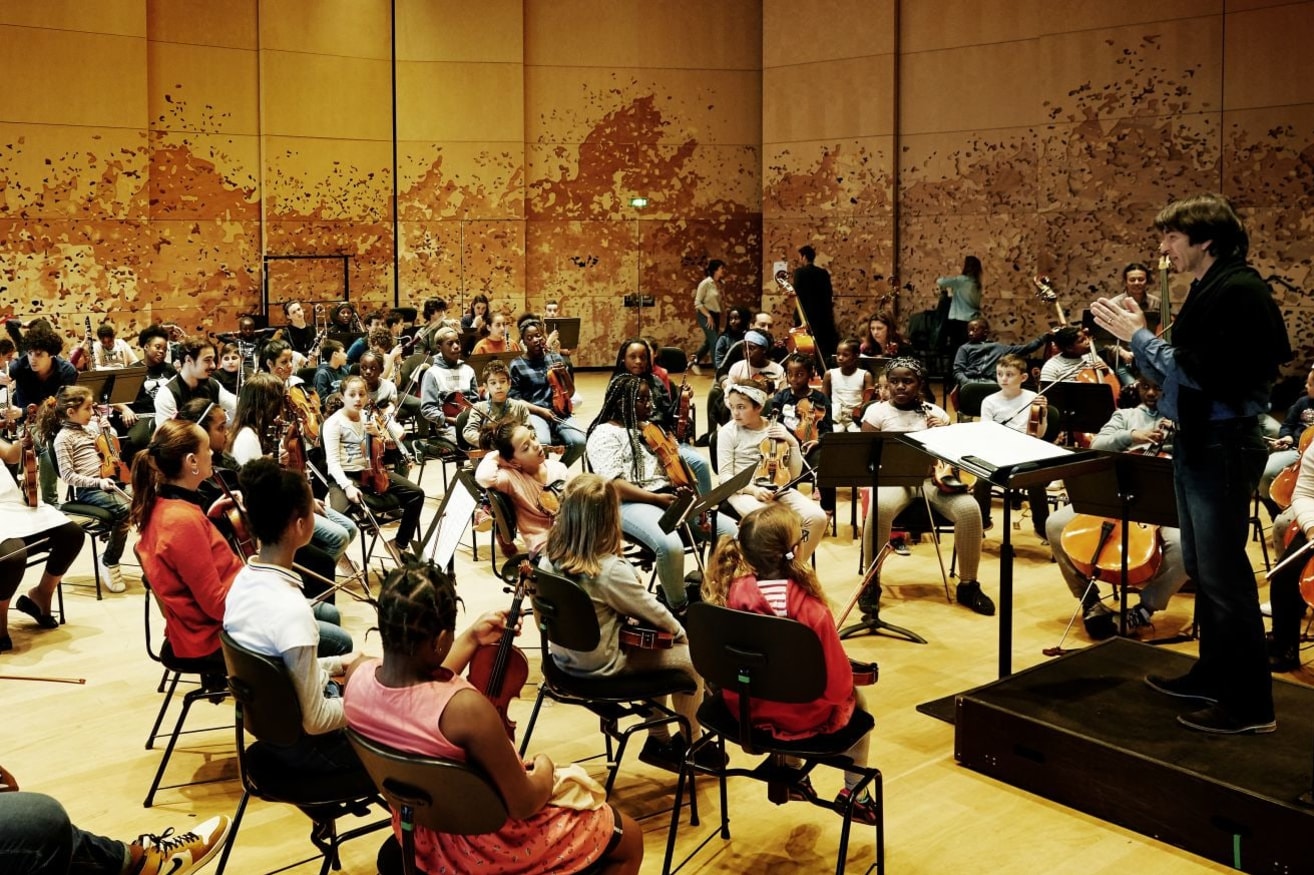
The children open their arms, bend, and throw a leg in cadence. In front of them, a conductor and a dancer guide them through movement after movement. To their left, a dozen musicians play Kalinifta, a traditional Greek-Italian song. Later, boys and girls sing along with no support other than the music and the conductor's voice. "Here, learning is done through the senses and orality," explains Lucas, their pedagogical advisor, who is also a trombonist. There is no music theory, just listening and group dynamics. We're in the Studio, one of the Philharmonie de Paris's finest rehearsal rooms, and the tutti students are the lucky beneficiaries of the Démos program, a music and orchestral education scheme with a social vocation.
FLUTE OR CLARINET?
During the break, eight-year-old Sally, a member of the children's group from 93 - living in Rosny - shared her experience with us. Like the hundred or so boys and girls present that day, she has been a member of the Grand Paris Grand Est orchestra, supported by DEMAIN, since September 2019. A few weeks ago, she was given the choice of learning the flute or clarinet. She opted for the flute. "The clarinet, I thought, was easy, but actually, I couldn't even place my mouth," she exclaims.
Is she enjoying the singing lessons? She nodded: "I didn't have the same voice before; it was deeper. I don't know where this voice was hiding." To help us discover it, she launched into Kalinifta, which turned out to be one of the two works the orchestra will be working on this year. Her voice rose, surprisingly powerful and clear for her frail frame. Not every note was spot on, but the emotion was there. Does she practice a lot at home? I sing when I'm bored, and I'm bored a lot," she replied mischievously.
AN INSTRUMENT ON LOAN
The three-year Démos program began with a one-and-a-half-day workshop during the All Saints' vacation. Since then, the orchestra has met twice weekly in small seminars and once a month in tutti. At first, the students familiarized themselves with music through dance and singing lessons and then got to grips with the instruments. Learning music theory is progressive and concomitant with instrumental practice, which is one of the differences with the conservatory.
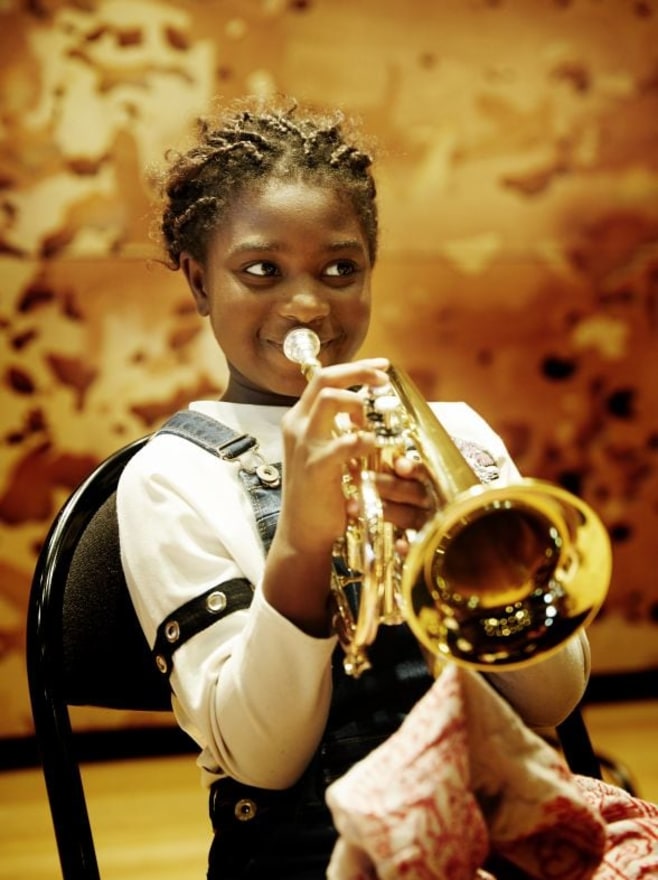
A few months ago, each student was assigned an instrument. The event is highly ritualized: the ceremony is often held in the presence of parents at the town hall. It's a turning point," says Lucas. The child becomes aware of the treasure entrusted to them. It's a three-year loan, but if the student pursues music beyond that - which happens in 50% of cases - they can keep it. "We are aware that the cost of the instrument is one of the main obstacles to learning," continues Lucas.
A SOCIAL INITIATIVE
The program has an artistic and educational objective - to introduce children to music - but also a social one - to help them find their place, both in the orchestra and in life. Students are recruited from social and cultural centers. To get in, you need to have never played music before, live in an area identified as needing a musical facility, be aged between seven and twelve, and be keen to learn.
Some children are naturally interested. Others have difficulties at school. In these cases, the program is an opportunity to get involved in a different, neutral, and caring environment. It's never a selection process: the social workers meet the parents, explain what's at stake - a three-year commitment needs to be carefully considered - and then it's up to the child to decide.
47 ORCHESTRAS IN FRANCE
Démos launched in 2010. In ten years, it has enabled 6,400 children to discover music. The program needs funding to run the orchestras—there are currently 47 across France—so DEMAIN, alongside other private sponsors, the French government, and local authorities, helps maintain the instruments, pays the professionals involved (teachers, educational and social advisors), and organizes the concerts.
Each orchestra performs in June in a venue close to where the children live," explains Emma, head of sponsorship for Démos. It's important to us that the orchestras have a solid local presence. The children perform in the Philharmonie's main hall at the end of the three-year program. Sally has no stage fright: "At first, I was scared on stage, but then I told myself it was as if I were all alone. I play in my head."
PLAYING, A MOMENT OF PEACE AND ENJOYMENT
This is one of the unique characteristics of the musicians trained by Démos, who continue to play beyond the program. While they may be less technically proficient due to their initial lack of music theory, they are more accustomed to playing in an orchestra, are better listeners, and are more at ease in public. Playing on stage is a moment of pleasure and joy for them," notes Emma. The bridging orchestras that bring together children from the conservatories and Demos children enable us to blend different visions and practices of music, which are mutually enriching.
The aim, however, is not to turn children into professional violinists or trumpeters. Above all, teaching at Démos has a civic function," explains Emma. The aim is to open them up to an aesthetic universe and help them gain self-confidence. We make sure that, at every stage, they feel they have succeeded. It is an unforgettable and structuring experience.
More information at www.demos.philharmoniedeparis.fr